Skip to content


Most practices do not lose revenue because of one bad decision. They lose it a little at a time: a missed modifier, a lapsed credential, a denied claim nobody appealed. By the time it shows up on a financial report, the problem is already months old.
That is the real question behind in-house vs. outsourced billing. It is not only about who submits your claims. It is about who is responsible for billing, coding, credentialing, and auditing, the four functions that together decide whether your practice collects what it is owed.
Here is how the two models compare across all four functions, with typical 2026 cost ranges you can check against your own numbers.
What Full-Stack RCM Includes
“Full-stack” is used loosely in this industry. In practice, it means four connected functions:
- Billing: charge entry, claim submission, payment posting, and accounts receivable follow-up
- Coding: turning clinical documentation into accurate, specialty-specific CPT, ICD-10, and HCPCS codes
- Credentialing: enrolling and re-enrolling providers with payers so claims are not rejected before review
- Auditing: regularly checking coding and documentation for errors, compliance risk, and missed reimbursement before they turn into denials
Most practices staff one or two of these well and neglect the rest. Auditing is skipped most often, usually until a payer audit forces the issue. That gap is where many outsourcing conversations begin.
In-House Full-Stack RCM: Costs and Requirements
Running all four functions internally means hiring and keeping a team with four different skill sets.
Billing
A biller or small billing team handles charge entry, claims, and A/R follow-up. Fully loaded with salary, benefits, software, training, and clearinghouse fees, an in-house biller typically costs $90,000 to $140,000 per year. Turnover adds more: replacing a biller costs roughly $4,000 to $7,000 in hiring, plus two to three months of lower productivity while the new hire learns the role.
Coding
In-house coders are often generalists covering several specialties, which is where specialty details get missed, such as anesthesia time units, ASC facility vs. professional fee splits, or E/M leveling in emergency medicine. The practice also pays directly for certification upkeep and continuing education.
Credentialing
Credentialing often falls to whoever has spare time, such as the office manager or billing lead, and is tracked in a spreadsheet. Missed re-credentialing deadlines are one of the most common and avoidable reasons clean claims are rejected, and slow enrollment for new providers can leave months of visits unbilled. See how credentialing delays affect revenue.
Auditing
Most in-house teams skip auditing entirely. Without it, coding and documentation errors are usually caught only after a denial, or during a payer compliance audit when the stakes are much higher. Our list of common medical billing errors shows what a good audit looks for.
In short, in-house billing gives you direct oversight, staff who know your practice, and no data sharing with a third party. But you carry every cost and risk yourself, with no backup if a key person leaves.
Outsourced Full-Stack RCM: What You Gain and Give Up
Outsourcing moves all four functions to a specialized team, usually priced as a percentage of collections (commonly 4% to 9%) or a flat per-claim or per-provider fee.
Billing
A dedicated team handles claim submission and A/R follow-up with no gaps for vacations, sick days, or turnover.
Coding
Reputable RCM partners assign certified coders with experience in your specialty, which reduces both under-coding (lost revenue) and over-coding (compliance risk).
Credentialing
Enrollment and re-enrollment become a tracked process instead of a side task, so fewer payments are delayed by lapsed payer enrollment. See our medical credentialing services.
Auditing
This is often where outsourcing pays off most clearly. Routine coding audits catch errors before claims go out instead of after they are denied.
The trade-off: you give up some day-to-day control and share patient and financial data with an outside company. That is why vendor due diligence matters as much as price. Use our HIPAA billing checklist and these warning signs of a weak billing partner when you compare vendors.
In-House vs. Outsourced RCM: Side-by-Side Comparison
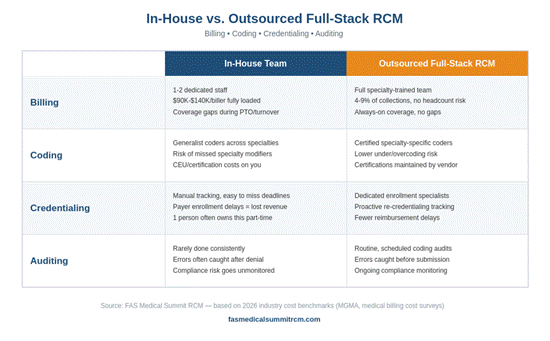
Figure 1: In-house vs. outsourced full-stack RCM across billing, coding, credentialing, and auditing
| Function | In-House Team | Outsourced Full-Stack RCM |
| Billing | 1 to 2 staff; $90K to $140K per biller, fully loaded | Full team; typically 4% to 9% of collections, no headcount risk |
| Coding | Generalist coders, possible specialty gaps | Certified, specialty-specific coders |
| Credentialing | Manual tracking, deadline risk | Dedicated enrollment specialists |
| Auditing | Rarely done consistently | Routine, scheduled coding audits |
| Coverage | Gaps during time off and turnover | Continuous |
| Scalability | Requires new hires to grow | Scales with claim volume |
| Compliance risk | Owned entirely by the practice | Shared with the vendor’s audit process |
| Control | Full, direct oversight | Managed through reporting and service agreements |
Total Cost Comparison
For a mid-size specialty practice collecting $2M to $3M a year, here is how total cost of ownership compares, including denial write-offs, not only salary vs. fee.
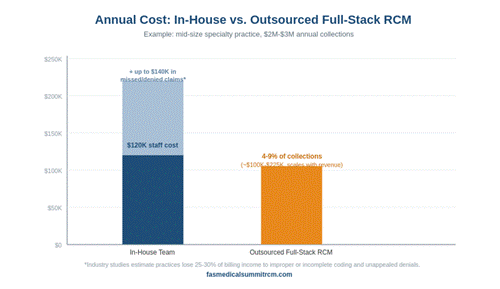
Figure 2: Annual cost comparison of an in-house team vs. outsourced full-stack RCM for a mid-size practice
- Fully loaded in-house billing typically costs $90,000 to $140,000 per biller per year.
- Outsourced full-stack RCM typically costs 4% to 9% of collections. For a $2.5M practice, that is roughly $100,000 to $225,000 a year, scaling with revenue.
- Coding errors and unappealed denials cost practices revenue under both models, but a dedicated audit process catches them more consistently.
The salary vs. fee comparison rarely tells the whole story. Denial write-offs and missed reimbursement usually drive total cost more than staffing does.
5 Hidden Costs Practices Often Miss
- Turnover and ramp-up time (in-house): new hires rarely work at full capacity for the first 60 to 90 days.
- Software and clearinghouse fees (in-house): practice management software, per-claim clearinghouse fees, and statement printing add up beyond salaries.
- Unappealed denials (both models): more common in-house when there is no dedicated audit function.
- Onboarding disruption (outsourced): a poorly managed transition can cause a temporary cash flow dip, so ask for a specific onboarding timeline before signing.
- Unclear vendor reporting (outsourced): if you cannot see denial rates, days in A/R, and first-pass acceptance rates in real time, you cannot confirm you are getting what you pay for.
Which Model Fits Your Practice?
The right choice depends on your size, specialty complexity, and internal capacity.
When In-House Makes Sense
- You are a large, multi-location group that can support a full internal RCM department, including a dedicated auditor
- You need maximum direct control over patient financial interactions
- You already have low denial rates and strong staff retention
When Outsourcing Fits Better
- You are a solo or small group practice (under 10 providers) without the volume to justify four separate specialists
- You work in a high-complexity specialty, such as ambulatory surgery centers, anesthesiology, pain management, or cardiology, where coding accuracy has a large revenue impact
- You have had billing or coding staff turnover in the past 12 months
- You have no routine auditing process today
The Hybrid Option
Many practices keep front desk and patient-facing billing in-house and outsource coding, credentialing, and auditing, the functions where specialty expertise matters most and errors are hardest to spot internally.
6 Questions to Ask an RCM Partner
- What does the fee include: billing only, or billing, coding, credentialing, and auditing together?
- How often are coding audits performed, and will I receive a written report?
- What is your first-pass claim acceptance rate in my specialty?
- How is patient data secured, and are you HIPAA compliant from end to end?
- What is the onboarding timeline, and how do you prevent cash flow disruption during the transition?
- Can you provide references from practices in my specialty?
Why Connected RCM Functions Perform Better
The strongest case for outsourcing is not cost alone. Billing, coding, credentialing, and auditing work better when they are connected. A coding audit finding helps only if it reaches the billing workflow right away, and a credentialing gap is caught in time only if someone tracks it against the billing calendar. That coordination is hard to achieve with separate in-house hires who rarely work together day to day.
A free revenue cycle audit is the fastest way to see where your current model, whether in-house, outsourced, or hybrid, is losing revenue. Learn about our revenue cycle management services.
In-House vs. Outsourced RCM FAQs
Is outsourcing medical billing more expensive than hiring in-house staff?
Usually not, once you count the full cost of an in-house hire: salary, benefits, software, turnover, and denial write-offs. Outsourced full-stack RCM typically costs 4% to 9% of collections, which is often less than the true total cost of an in-house team.
Can I outsource only coding and auditing and keep billing in-house?
Yes. Many practices use a hybrid model, outsourcing the functions that need the deepest specialty expertise, coding and auditing, while keeping daily billing and patient interactions in-house.
How often should coding audits happen?
At least quarterly. High-complexity specialties such as ASCs, anesthesiology, and cardiology benefit from more frequent audits because coding errors there cost more per claim.
Will outsourcing reduce my visibility into billing?
It should not. A good RCM partner provides real-time reporting on claim status, denial rates, and days in A/R, which usually means more visibility than a spreadsheet-based in-house process.
What credentials should an outsourced RCM partner have?
Look for certified coders (CPC or CCS), HIPAA-compliant data handling, experience in your specialty, transparent reporting, and references from practices similar to yours.