

Most practices don’t lose revenue because of one bad decision. They lose it a little at a time — a missed modifier here, a lapsed credential there, a denied claim nobody appealed. By the time it shows up on a financial report, it’s already months old.
That’s the real question behind “in-house vs. outsourced billing.” It was never just about who submits your claims. It’s about who’s responsible for billing, coding, credentialing, and auditing — the four functions that together determine whether your practice collects what it’s actually owed.
This guide breaks down both models side by side, with real 2026 cost benchmarks, so you can make a decision based on numbers instead of guesswork.
What “Full-Stack RCM” Actually Includes
“Full-stack” gets used loosely in this industry, so here’s what it means in practice — four connected functions, not one:
- Billing — charge entry, claim submission, payment posting, and accounts receivable follow-up
- Coding — translating clinical documentation into accurate, specialty-specific CPT, ICD-10, and HCPCS codes
- Credentialing — enrolling and re-enrolling providers with payers so claims aren’t rejected before they’re even reviewed
- Auditing — routinely checking coding and documentation for errors, compliance risk, and missed reimbursement before they turn into denials
Most practices staff for one or two of these well and treat the rest as an afterthought. Auditing especially tends to get skipped entirely until a payer audit forces the issue. That gap is where a lot of outsourcing conversations start.
In-House Full-Stack RCM: What It Really Costs and Requires
Running all four functions internally means building — and keeping — a team with four different skill sets.
Billing. A single biller or small billing team handles charge entry, claims, and AR follow-up. Fully loaded — salary, benefits, software, training, and clearinghouse fees — an in-house biller typically costs $90,000 to $140,000 per year. Add turnover, and the real number climbs further: replacing a biller runs $4,000 to $7,000 in hiring costs, plus two to three months of reduced productivity while the new hire ramps up.
Coding. In-house coders are often generalists covering multiple specialties, which is where specialty-specific modifiers and edge cases get missed — anesthesia time units, ASC facility vs. professional fee splits, or E/M level nuances in emergency medicine. Certification maintenance (CEUs, credentialing) is an ongoing cost your practice absorbs directly.
Credentialing. This function often falls to whoever has spare time — a front-office manager or the billing lead — tracked manually in a spreadsheet. Missed re-credentialing deadlines are one of the most common (and most avoidable) causes of clean claims getting rejected before they’re ever reviewed for payment.
Auditing. This is the function most in-house teams skip entirely. Without a dedicated audit process, coding and documentation errors are usually only caught after a claim is denied — or worse, during a payer compliance audit, when the stakes are much higher.
The bottom line: in-house control comes with real upside — direct oversight, staff who know your practice, no data-sharing with a third party. But it also means you own every one of these costs and risks directly, with no built-in redundancy if a key staff member leaves.
Outsourced Full-Stack RCM: What You Get and What You Give Up
Outsourcing shifts all four functions to a specialized team, typically priced as a percentage of collections (4-9%) or a flat per-claim / per-provider fee.
Billing. A dedicated team handles claims submission and AR follow-up with no coverage gaps for PTO, sick days, or turnover — someone is always working your claims.
Coding. Reputable RCM partners assign certified coders with specialty-specific experience, which directly reduces under-coding (leaving money on the table) and over-coding (a compliance liability).
Credentialing. Enrollment and re-enrollment become a tracked, proactive process instead of a side task — fewer reimbursement delays caused by lapsed payer contracts.
Auditing. This is where outsourcing tends to show the clearest ROI. Routine coding audits catch errors before claims go out, not after they’re denied — closing the gap most in-house teams never get to.
The trade-off: you give up some direct day-to-day control and share patient/financial data with an outside vendor — which is exactly why vendor due diligence (HIPAA compliance, references, reporting transparency) matters as much as pricing.
In-House vs. Outsourced: Side-by-Side Comparison
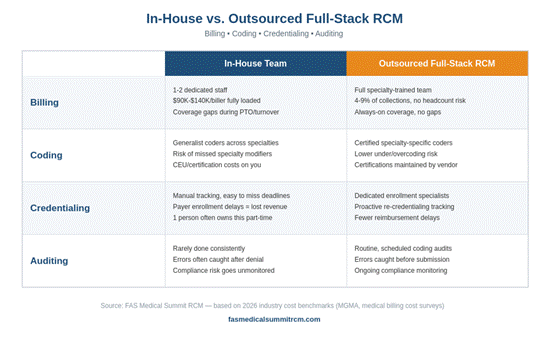
Figure 1: In-house vs. outsourced full-stack RCM across billing, coding, credentialing, and auditing
| Function | In-House Team | Outsourced Full-Stack RCM |
| Billing | 1-2 staff; $90K-$140K/biller fully loaded | Full team; 4-9% of collections, no headcount risk |
| Coding | Generalist coders, specialty gaps possible | Certified specialty-specific coders |
| Credentialing | Manual tracking, deadline risk | Dedicated enrollment specialists |
| Auditing | Rarely done consistently | Routine, scheduled coding audits |
| Coverage | Gaps during PTO/turnover | Always-on |
| Scalability | Requires new hires to grow | Scales with claim volume automatically |
| Compliance risk | Owned entirely by the practice | Shared with vendor’s audit process |
| Control | Full, direct oversight | Managed through reporting/SLAs |
What This Actually Costs: Real Numbers
For a mid-size specialty practice collecting $2M-$3M annually, here’s how the total cost of ownership compares — not just salary vs. fee, but the full picture including denial write-offs.
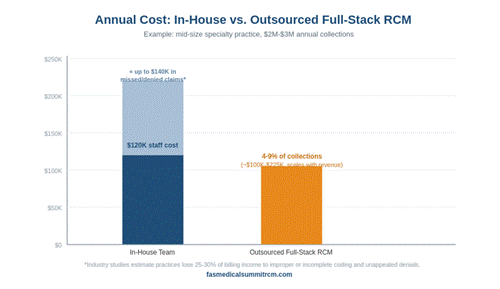
Figure 2: Annual cost comparison — in-house team vs. outsourced full-stack RCM for a mid-size practice
A few data points worth sitting with:
- Fully loaded, in-house billing typically runs $90,000-$140,000 per biller per year.
- Outsourced full-stack RCM typically runs 4-9% of collections — for a $2.5M practice, roughly $100,000-$225,000 annually, scaling directly with revenue.
- Industry studies estimate practices lose 25-30% of billing income to improper or incomplete coding and unappealed denials — a cost that hits both models, but tends to be more consistently caught by dedicated outsourced audit processes.
- According to a 2025 Medical Group Management Association (MGMA) report, nearly 60% of practices with fewer than 10 physicians are now considering outsourcing at least part of their billing operations.
The headline salary-vs-fee comparison rarely tells the full story. The bigger driver of total cost is usually denial write-offs and missed reimbursement — not staffing costs alone.
Hidden Costs Most Practices Don’t Budget For
Whichever model you choose, watch for these:
- Staff turnover and ramp-up time (in-house) — a new hire rarely performs at full capacity for the first 60-90 days.
- Software and clearinghouse fees stacking up (in-house) — practice management software, clearinghouse per-claim fees, and statement printing add up outside the base salary.
- Denial write-offs going unappealed (both models, but more common in-house without a dedicated audit function).
- Vendor onboarding disruption (outsourced) — a poorly managed transition can cause a temporary dip in cash flow; ask any prospective partner for a specific onboarding timeline before signing.
- Opaque vendor reporting (outsourced) — if you can’t see denial rates, days in A/R, and first-pass claim rates in real time, you can’t verify you’re getting what you’re paying for.
Which Model Fits Which Practice?
There’s no universal right answer — it depends on your size, specialty complexity, and internal bandwidth.
In-house may make sense if:
- You’re a large, multi-location group that can justify a full internal RCM department, including a dedicated auditor
- You need maximum direct control over patient financial interactions
- You already have low denial rates and strong staff retention
Outsourced full-stack RCM tends to fit better if:
- You’re a solo or small group practice (under 10 providers) without the volume to justify four separate specialists
- You’re in a high-complexity specialty — ASC, anesthesiology, pain management, cardiology — where coding accuracy has an outsized revenue impact
- You’ve had staff turnover in billing or coding roles in the past 12 months
- You don’t currently have any routine auditing process in place
A hybrid model is common too. Many practices keep front-desk and patient-facing billing functions in-house while outsourcing coding, credentialing, and auditing — the functions where specialty expertise matters most and errors are hardest to self-detect.
Questions to Ask Before You Decide
1. What’s included in the fee — billing only, or billing, coding, credentialing, and auditing together?
2. How often are coding audits performed, and do you receive a written report?
3. What’s your first-pass claim acceptance rate, by specialty?
4. How is patient data secured, and are you HIPAA compliant end-to-end?
5. What does the onboarding timeline look like, and how do you prevent cash-flow disruption during transition?
6. Can you provide references from practices in my specific specialty?
How Full-Stack RCM Works When It’s Done Right
The strongest argument for outsourcing isn’t cost alone — it’s that billing, coding, credentialing, and auditing perform better when they’re connected instead of siloed. A coding audit finding is only useful if it feeds back into the billing workflow immediately. A credentialing gap only gets caught in time if someone is actively tracking it against your billing calendar. That coordination is difficult to replicate with separate in-house hires who rarely talk to each other day to day.
If you’re evaluating this decision for your own practice, a free revenue cycle audit is the fastest way to see where your current model — in-house, outsourced, or hybrid — is actually leaving money on the table.
Schedule a free RCM audit →
Frequently Asked Questions
Is outsourcing medical billing more expensive than hiring in-house staff?
Not usually, once you account for the full cost of an in-house hire — salary, benefits, software, turnover, and denial write-offs. Outsourced full-stack RCM typically costs 4-9% of collections, which is often lower than the true total cost of an in-house team once hidden costs are included.
Can I outsource just coding and auditing while keeping billing in-house?
Yes. Many practices use a hybrid model, outsourcing the functions that require the deepest specialty expertise — coding and auditing — while keeping day-to-day billing and patient interactions in-house.
How often should coding audits happen?
At minimum, quarterly. High-complexity specialties like ASC, anesthesiology, and cardiology benefit from more frequent audits, since coding errors in these areas tend to carry a higher dollar impact per claim.
Does outsourcing mean I lose visibility into my billing?
It shouldn’t. A good RCM partner provides real-time reporting on claims status, denial rates, and days in A/R — you should have more visibility, not less, compared to a spreadsheet-based in-house process.
What credentials should I look for in an outsourced RCM partner?
Look for certified coders (CPC/CCS), HIPAA-compliant data handling, specialty-specific experience in your field, transparent reporting, and references from practices similar to yours in size and specialty.